
Three methods, three very different commitments. The right one depends less on which is “best” and more on your hair type, your patience, and how you actually live day to day.
The short version: tape-ins are the fastest to fit and the kindest to fine hair. Micro beads use no heat or glue and suit people who want to reposition often. Fusion lasts longest and moves most naturally, but asks the most of your hair and your budget.
Side by side
| Tape-in | Micro bead | Fusion | |
|---|---|---|---|
| How it attaches | Adhesive wefts sandwiched around your own hair | Small silicone-lined rings clamped closed | Keratin bonds melted onto small sections |
| Heat or glue | Adhesive, no heat | Neither | Heat |
| Fitting time | Shortest | Moderate | Longest |
| Move-up interval | Most often | Regular | Least often |
| Best for | Fine to medium hair, first-timers | Medium hair, frequent repositioning | Medium to thick hair, longest wear |
| Watch out for | Visible in very fine hair if placed too high | Beads can slip if hair is very silky | Hardest to remove; needs a skilled hand |
Tape-in extensions
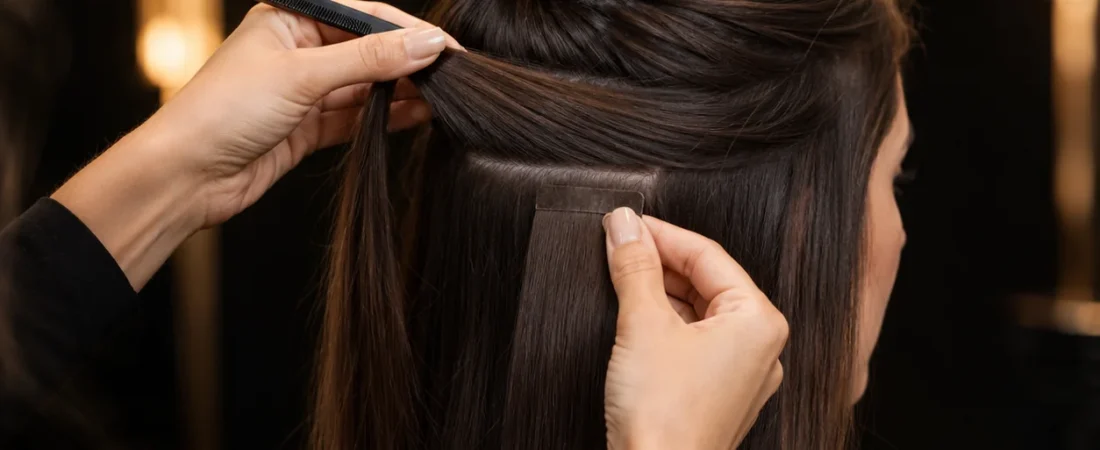
Thin wefts with a medical-grade adhesive strip, applied in pairs so your own hair sits sandwiched between them. They lie flat, which is why they are the usual recommendation for fine hair — there is no bulky join to hide.
They are also the quickest to fit, which makes them the least intimidating place to start if you have never worn extensions. The trade-off is the move-up cycle: as your hair grows the tapes travel down and need repositioning more often than the other two methods.
Choose tape-ins if your hair is fine to medium, you want length without a long appointment, and you would rather come back more often than commit to something harder to remove.
Micro bead extensions
Also called micro-link or micro-ring. Small rings lined with silicone are threaded over a section of your hair together with the extension strand, then clamped closed. No heat, no adhesive — purely mechanical.
That makes them the most adjustable of the three. A bead can be opened, moved and re-closed, so maintenance is genuinely a reposition rather than a removal and refit. For anyone nervous about chemicals or heat near their hair, this is usually the reassuring option.
The caveat is grip. Very silky or very fine hair can slide within a bead, and over-tightening to compensate is where tension damage comes from. Placement and bead size matter more here than with any other method.
Choose micro beads if you want no heat and no adhesive, your hair has enough body to hold a bead, and you like the idea of adjusting rather than replacing.
Fusion extensions
Individual strands tipped with keratin, bonded to small sections of your own hair with a heat tool. The bonds are tiny, which is why fusion moves the most naturally — you can wear your hair up, part it anywhere, and there is nothing to conceal.
It also lasts the longest between appointments. The cost of that is the fitting: it is the longest appointment of the three, and removal has to be done properly with a bond remover rather than pulled. Done badly, fusion is the method most likely to leave you with breakage.
Choose fusion if you have medium to thick hair, you want the most natural movement and the longest wear, and you are happy to sit for a longer appointment to get it.
What actually decides it
In practice the decision comes down to four questions, and none of them is “which method is best”.
- How much hair do you have to work with? Extensions need something to attach to. Fine or thinning hair narrows the options and makes placement more important than method.
- How often will you realistically come back? Every method needs maintenance. Choosing the one with the longest interval only helps if you keep the appointment.
- What does your hair go through? Daily heat styling, swimming, gym, a job that means hair up every day — all of it changes which attachment holds up.
- What is the actual goal? Adding length is a different brief from adding density, and density often needs less hair than people expect.
Why we quote at consultation
You will notice we publish prices for everything else — keratin treatments from $250, perms from $150, gloss from $40 — but not for extensions. That is deliberate.
Extension pricing is driven by how much hair you actually need, and that varies more than any other service we offer. Two people wanting “shoulder length to mid-back” can need very different amounts depending on density. Quoting a headline figure online would mean quoting one that is wrong for most people who read it.
So the consultation comes first: we look at your hair condition, your lifestyle and your maintenance expectations, then recommend a method and give you a real number.
Extension consultations in Port Credit, Mississauga.
We will tell you honestly if extensions are not the right call for your hair.
or call (437) 473-1010